3 to 6 years
Junior Primary
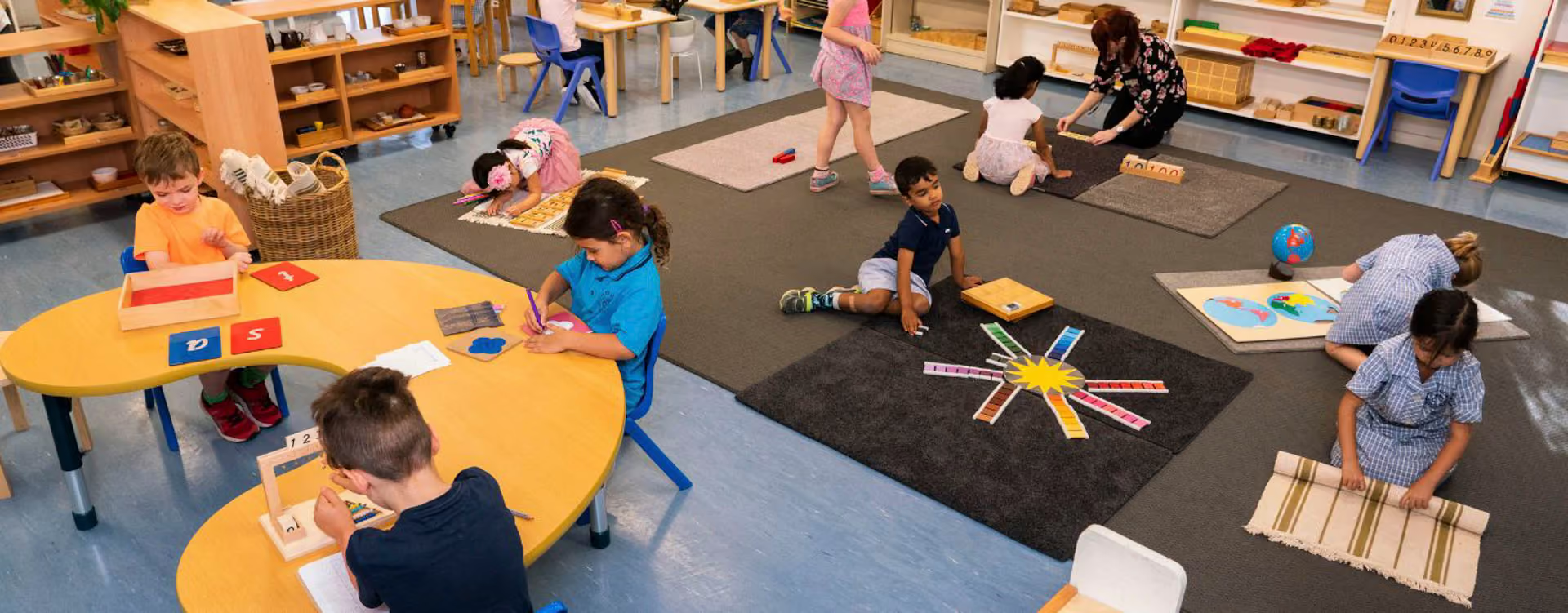
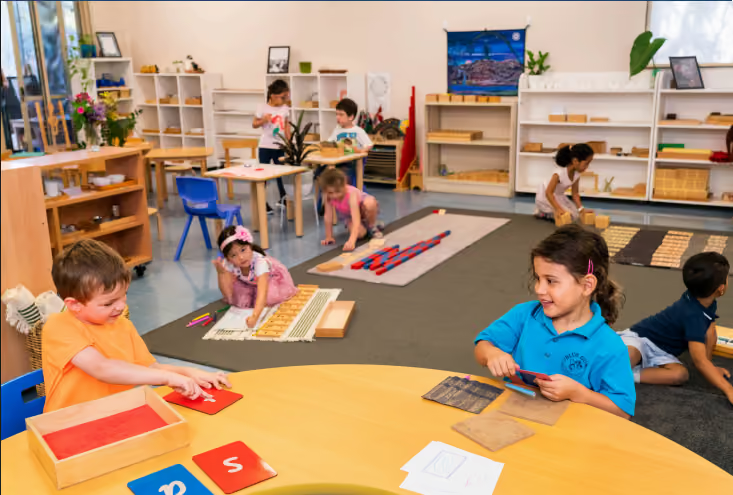
In a classroom adapted to their developmental needs and innate capabilities, children direct their movements in purposeful activity. Independent effort is encouraged and protected, concentration is allowed to grow, and individuality is honoured.
Dr. Maria Montessori believed that children naturally possess a positive attitude towards learning — we foster this every day at Blue Gum.
The five areas of the Junior Primary classroom
Each area of the prepared environment invites the child to work at their own pace, with materials that make abstract ideas concrete and learning joyful.
01
Practical Life
Practical Life includes some of the daily routines your child has already seen at home: preparing food, washing dishes, dressing oneself and communicating with others. These real life tasks provide a link between what happens at school and at home. They encourage concentration, inner discipline, coordination and independence, and indirectly prepare children for writing and reading — helping each child find a sense of belonging in their classroom community.
02
Sensorial Activities
Sensorial activities were designed by Dr. Maria Montessori to help children express and classify their sensory experiences. By educating the senses we are not trying to make the child see better, but helping them to know what they see. These exercises build exploration, observation, problem solving and order, and prepare the way for mathematics, language, science and geography.
03
Language Activities
Language activities cover all elements of spoken and written language, taught in a sequential yet integrated way. Spoken language is elaborated through songs, games, poems, stories and pictures. With materials such as the sandpaper letters and moveable alphabet, children link phonetic sounds to letter symbols, compose their own written work and read the work of others.
04
Mathematics Activities
Mathematics builds on the skills learnt in Practical Life and Sensorial work, as well as the mathematical experiences children meet in daily life. Concepts are introduced with concrete materials, developing number quantity and recognition, counting and sequencing, before moving to the decimal system and the processes of addition, subtraction, multiplication and division.
05
Cultural Activities
Cultural activities help children develop an awareness and appreciation of the world through geography, biology, science, history, technologies and the arts. Educators share the wonder and beauty of the Earth, focusing on real experiences and inquiry learning, promoting higher order critical and investigative thinking.
Come and see a Junior Primary morning
The best way to understand Montessori is to watch children at work. Book a classroom observation at our Bibra Lake campus.
Acknowledgement of Country
Blue Gum Montessori School acknowledges the Noongar people of Beeliar Boodja, the land on which we work, learn and play.
We acknowledge their continuing connection to land, waters and culture and pay our respects to Elders past, present and emerging.
Montessori Trust Statement

Blue Gum Montessori School is committed to a pathway of growth and improvement in genuine Montessori practice.
