
How Does Montessori Teach Maths? A Guide for Parents






How Does Montessori Teach Maths? A Guide for Parents
Maths is one of the areas parents often have questions about when they first explore Montessori education.
Without a teacher standing at the front of the classroom taking every child through the same worksheet at the same time, how does Montessori teach maths? And how do children move from hands-on materials to the more abstract mathematics they will need as they progress through school?
The Montessori approach follows a carefully sequenced pathway. Children begin by seeing, touching and working with mathematical concepts in a concrete way before gradually moving towards numbers, symbols and abstract problem solving.
The aim is not simply to memorise a process. It is to help children understand why the maths works.
Maths Starts with Something Children Can See and Touch
For younger children, an abstract idea such as 1,000 or multiplication can be difficult to understand when it exists only as a number on a page.
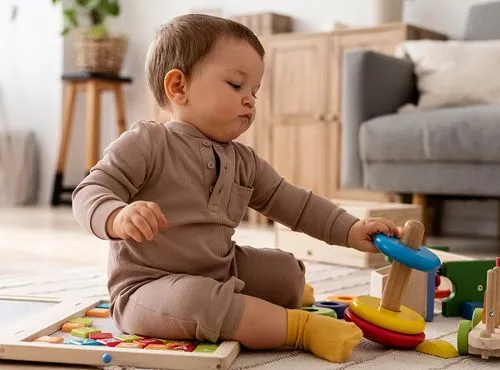
Montessori mathematics begins by making these ideas physical.
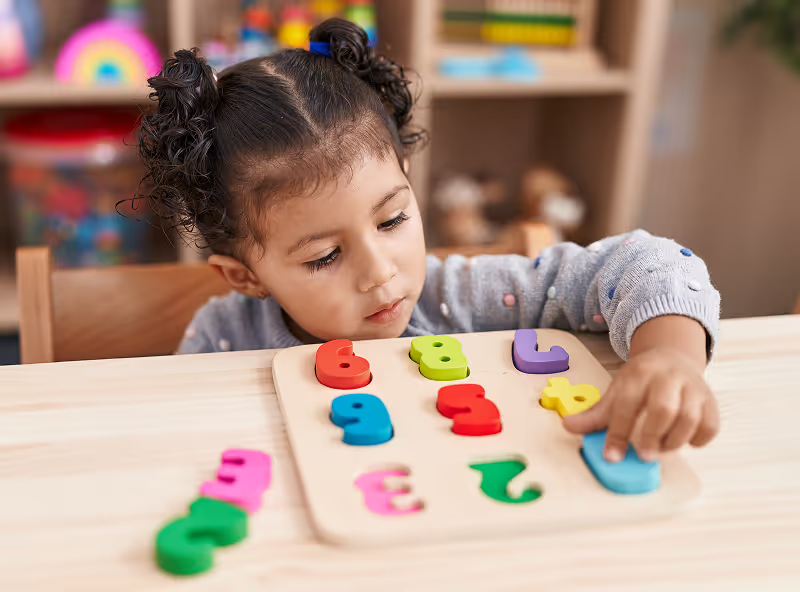
In Montessori mathematics in Junior Primary, children work with carefully designed materials that allow them to explore quantity, number recognition, counting and sequencing. As their understanding develops, these experiences introduce increasingly complex ideas such as the decimal system and the four mathematical operations.
This means a child is not simply being told that one number is larger than another. They can see and handle the difference.
Moving from Concrete to Abstract
One of the most important ideas in Montessori maths is the progression from concrete understanding to abstract thinking.
The materials are not the end goal.
They provide a bridge that allows children to understand a concept physically before they are expected to solve it using numbers and symbols alone.
As children progress through the primary years, they gradually rely less on the materials. The mathematical understanding they have built allows them to move into more abstract work with confidence.
By Middle Primary at Blue Gum Montessori, children are developing areas including arithmetic, geometry and algebra while continuing to use Montessori materials where they help clarify increasingly complex ideas.
Understanding Before Memorising
Children still need fluency with numbers, operations and mathematical facts, but Montessori aims to build understanding alongside that fluency.
Rather than learning a procedure without understanding why it works, children encounter the concept first and practise it in different ways.
For example, mathematical learning may involve:
- Exploring quantity before introducing the written symbol
- Physically working through an operation before recording it on paper
- Repeating a concept until the child demonstrates understanding
- Revisiting mathematical ideas at increasing levels of complexity
This progression helps children form connections between mathematical ideas rather than viewing each new topic as an unrelated set of rules.
Children Can Progress at Different Rates
A Montessori classroom does not assume that every child will need exactly the same lesson at exactly the same moment.
At Blue Gum Montessori, this sits within a defined Maths curriculum sequence, which provides the framework for teachers’ observations, lesson presentations and progression through mathematical concepts.
A child who needs additional time with a concept can continue working with it. A child who has demonstrated a secure understanding can progress into more challenging work.
That does not mean maths is unstructured or optional. The Maths curriculum sequence follows a deliberate progression, while still allowing children the time to build a secure understanding before moving forward.
This reflects the broader Blue Gum Montessori curriculum, where concepts are revisited over successive years with increasing levels of abstraction and complexity.
What Does the Teacher Do?
Montessori maths is sometimes misunderstood as children simply selecting whatever they would like to do.
That is not how the classroom works.
Teachers actively observe, assess and introduce lessons. They monitor each child's progress and make sure they are developing across the required areas of mathematics.
The difference is that instruction can happen individually or in smaller groups, allowing the educator to respond more closely to what each child understands and what they are ready to learn next.
The classroom may look different from a conventional whole-class maths lesson, but the lesson presentations themselves involve explicit teaching and instruction, alongside ongoing assessment and progression.
How Does This Translate Into Academic Results?
Parents quite reasonably want to know whether an approach built around hands-on learning and individual progression produces strong academic foundations.
Blue Gum Montessori's recent numeracy results provide useful context.
In the school's 2025 NAPLAN results:
- Year 3 students recorded an average numeracy score of 477, compared with a national average of 405
- Year 5 students recorded an average numeracy score of 547, compared with a national average of 492
- 90% of Year 3 students achieved within the top two NAPLAN achievement levels for numeracy
- 91% of Year 5 students achieved within the top two achievement levels for numeracy
Those results are particularly useful because Blue Gum does not build its entire school year around preparing children for NAPLAN.
NAPLAN is only one measure of learning, and it does not capture everything Montessori education aims to develop. But the results do provide reassurance for parents wondering whether a different approach to teaching mathematics can also deliver strong academic outcomes.
You can read more in Blue Gum Montessori's 2025 NAPLAN results.
Mathematics Beyond Getting the Right Answer
Strong mathematics is about more than completing calculations correctly.
Children also need to learn how to reason, recognise patterns, persist when an answer is not immediately obvious and approach unfamiliar problems with confidence.
The Montessori approach gives children time to explore these skills alongside the mathematical concepts themselves.
As children progress through Junior, Middle and Upper Primary, the aim is to gradually develop learners who can use mathematics independently rather than relying on an adult to tell them every next step.
See Montessori Maths in the Classroom
The materials and progression used in Montessori mathematics make much more sense when you see them being used.
During a school visit, parents can observe how children work with mathematical materials, how educators introduce new concepts and how children at different stages progress from concrete learning towards abstract mathematics.
If you are curious about how Montessori maths works for your child, the best next step is to book a school tour.




Ready to begin?
Start your Fast Track Enrolment today or contact the Registrar if you would like to discuss your family’s circumstances first.
Acknowledgement of Country
Montessori Trust Statement