Does Montessori Follow the Australian Curriculum? What Parents Need to Know






Does Montessori Follow the Australian Curriculum? What Parents Need to Know
One of the most common questions parents have when considering Montessori education is whether children still follow the Australian Curriculum.
It is an understandable question. Montessori classrooms can look quite different from traditional classrooms, with mixed-age groups, hands-on materials, longer work cycles and children progressing through lessons at different stages.
But different does not mean disconnected from recognised curriculum requirements.
At Blue Gum Montessori School, the Montessori approach sits within a clear curriculum framework that meets national and Western Australian requirements while allowing children to learn through authentic Montessori methods.
So, Does Montessori Follow the Australian Curriculum?
The simple answer is yes, but the way the curriculum is delivered looks different.
Blue Gum Montessori implements the Montessori National Curriculum, which is recognised by the Australian Curriculum, Assessment and Reporting Authority as an alternative national curriculum framework.
The school also works within Western Australian curriculum requirements and has approval from the School Curriculum and Standards Authority to implement the Montessori National Curriculum as an alternative curriculum.
You can read more about Blue Gum’s curriculum structure on our Montessori Curriculum page.
What changes is not whether children learn mathematics, English, science, humanities, the arts and other key learning areas. It is how those concepts are introduced, connected and developed over time.
A Different Way of Organising Learning
In many traditional classrooms, subjects are separated into distinct lessons and children of the same age generally move through the curriculum together.
Montessori takes a different approach.
The curriculum is organised as a connected sequence of learning, with concepts revisited over time at increasing levels of complexity. Children may first encounter an idea through concrete materials or a practical experience before gradually moving towards more abstract understanding.
This creates a progression where children can build a strong foundation before moving forward, rather than simply covering a topic because it appears on the timetable that week.
There Is Still a Clear Curriculum Sequence
One misconception about Montessori education is that children simply choose whatever they would like to learn each day.
That is not how the classroom operates. Blue Gum Montessori has defined curriculum sequences that provide the framework for teachers' observations, lesson presentations and student progression.
Teachers know which concepts need to be introduced and where children are sitting within that sequence. Observation allows them to decide when an individual child or small group is ready for the next lesson. This gives children some flexibility in the pace of their learning without removing structure or academic expectations.
Montessori Teaching Includes Explicit Instruction
Another misconception is that Montessori teachers do not directly teach.
Montessori lesson presentations involve explicit teaching and instruction. Teachers introduce concepts clearly, demonstrate materials and processes, observe children's understanding and provide further lessons as children progress.
The difference is that explicit instruction does not always happen as one whole-class lesson delivered to every child at exactly the same time. It may take place individually or in small groups, allowing the teacher to respond more closely to what each child already understands and what they are ready to learn next.
We explored this in more detail in our article How Does Montessori Teach Maths? A Guide for Parents.
What About Core Subjects Like Maths and English?
Core academic learning remains an important part of Montessori education.
At Blue Gum, the curriculum includes areas such as English and language, mathematics, science, geography, history, visual and performing arts, health and physical education, technologies and languages.
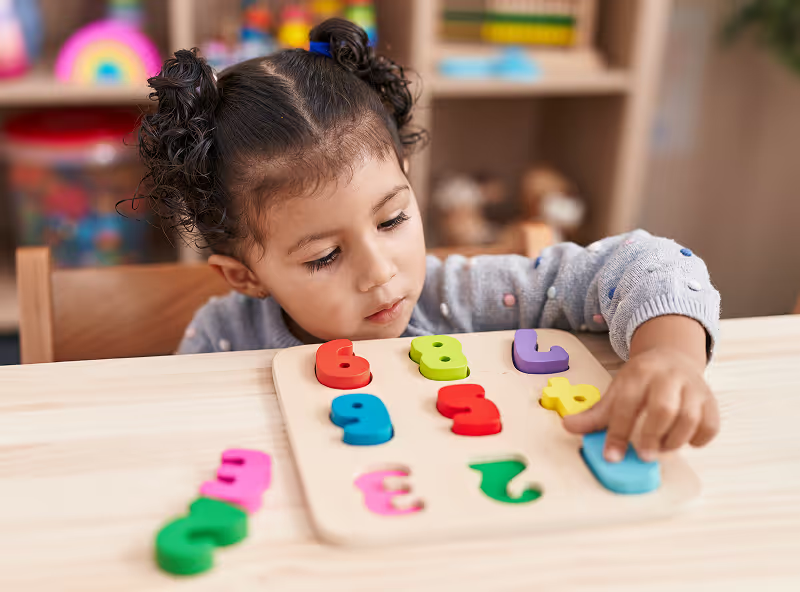
What parents may notice is that the learning can look different. In mathematics, for example, children often begin with concrete materials that allow them to physically experience concepts before moving towards abstract calculations. In language, learning develops through a sequence that builds vocabulary, writing, reading, grammar and comprehension.
The Montessori method aims to give children an understanding of the concept itself, not simply the ability to reproduce an answer.
What Happens if Children Learn at Different Rates?
Children do not all understand the same concept at exactly the same time.
Montessori recognises this while still maintaining a clear curriculum sequence. A child who requires more time with a concept can continue practising and receiving support. Another child who has demonstrated secure understanding can move into more advanced work. This does not mean children can simply skip important areas of learning. Teachers monitor progress across the curriculum and use observation, assessment and lesson planning to ensure children continue developing across the required learning areas.
The flexibility is in how and when children reach understanding, not whether the learning happens.
How Do Parents Know the Approach Is Academically Sound?
Curriculum recognition provides one important level of assurance.
The Montessori National Curriculum has been recognised by ACARA as an alternative curriculum framework capable of delivering comparable educational outcomes, while Western Australian schools implementing an alternative curriculum operate within SCSA requirements.
Academic results can provide another useful piece of information.
Blue Gum’s recent NAPLAN performance has shown strong results in areas including numeracy. NAPLAN is only one measure of learning, but it provides parents with an external point of comparison alongside the broader outcomes Montessori education aims to develop.
You can view more detail in Blue Gum Montessori's 2025 NAPLAN results.
Curriculum Is Only Part of the Picture
Meeting curriculum requirements is important, but education is about more than covering content.
Montessori also places significant emphasis on helping children develop independence, concentration, responsibility, problem solving and confidence. The aim is for children to understand what they are learning, recognise connections between different areas of knowledge and gradually become more capable of managing their own learning.
This is one of the reasons a Montessori classroom can look different while still providing strong academic foundations.
Authentic Montessori Within a Recognised Framework
For parents comparing schools, it is worth understanding both sides of the equation.
A Montessori school should be able to demonstrate authentic Montessori practice, while also clearly explaining its curriculum, teaching sequence, assessment and regulatory requirements. Blue Gum Montessori combines recognised curriculum frameworks with Montessori-trained educators, structured curriculum sequences and ongoing engagement with recognised Montessori organisations.
You can read more about what to look for in our guide How to Know if a Montessori School Is Authentic.
Come and See How It Works
Curriculum documents can explain what children learn, but seeing the classroom often makes the approach much easier to understand.
A school visit gives parents the opportunity to see explicit lesson presentations, Montessori materials, independent work and teacher guidance happening within the same environment.
If you are considering Montessori education for your child, you can book a school tour and see how the curriculum works in practice.






Ready to begin?
Start your Fast Track Enrolment today or contact the Registrar if you would like to discuss your family’s circumstances first.
Acknowledgement of Country
Montessori Trust Statement